


How to Use Trekking Poles Correctly: The Complete Guide to Better Hiking

Everything you need to know about choosing, adjusting, and using trekking poles for maximum comfort, efficiency, and stability.
Quick Answer
The correct way to use trekking poles is to adjust them so your elbows form approximately a 90-degree angle on level terrain, insert your hands up through the wrist straps, and plant the opposite pole with each step. Shorten your poles for uphill climbs, lengthen them for descents, and allow the straps—not your grip strength—to support much of your weight.
When used properly, trekking poles improve balance, reduce joint stress, increase endurance, and help hikers move more efficiently across nearly every type of terrain.
Why Use Trekking Poles?
Many hikers initially think trekking poles are simply for balance. While they certainly provide stability, their biggest advantage is their ability to improve overall hiking efficiency.
Proper pole technique allows your upper body to share the workload with your legs. Instead of relying entirely on your knees and hips, trekking poles engage your shoulders, arms, chest, and core.
Benefits include:
- Improved stability on uneven terrain
- Enhanced propulsion when climbing
- Reduced impact on knees during descents
- Better posture making it easier to breathe
- Increased uphill efficiency
- More confidence while crossing streams or snowfields
- Better balance with heavy backpacks
- Reduced fatigue on long hikes
For many hikers, trekking poles become one piece of gear they never hike without.
Step 1: Adjust Your Trekking Poles
Pole length affects comfort more than almost any other factor.
On Level Ground
Stand naturally with feet shoulder width apart.
Adjust the pole so that when gripping the pole with the tip on the ground, your forearm is parallel to the ground, and your elbow forms approximately a 90-degree angle.
This provides the ideal combination of leverage and comfort.
For Uphill Hiking
Shorten both poles approximately 2–4 inches (5–10 cm).
Shorter poles increase propulsion and allow you to keep your hands in a comfortable position while climbing steep terrain. This alleviates strain on the shoulders and upper back.
For Downhill Hiking
Lengthen both poles approximately 2–4 inches.
Longer poles provide earlier ground contact, improving stability while reducing stress on your knees.
Sidehill Traverses
One of the biggest advantages of adjustable trekking poles is adapting to uneven terrain.
When traversing a slope:
- Shorten the uphill pole
- Lengthen the downhill pole
This keeps your shoulders level and dramatically improves balance and reduces fatigue.
Step 2: Use the Wrist Straps Correctly
This is the most common mistake hikers make.
Many people simply grab the grip from above and ignore the straps.
Instead:
- Reach your hand up through the bottom of the strap
- Wrap your hand around both the grip and the section of strap in your palm.
- Allow the strap to support much of your body weight
Proper strap use:
- Reduces hand fatigue
- Improves control
- Prevents over-gripping
- Makes hiking more efficient
Your hands should remain relaxed, not squeezed tightly around the grip.
Step 3: Learn the Proper Walking Rhythm
On flat terrain, trekking poles naturally follow your walking motion.
As your left foot moves forward, plant the right pole.
As your right foot moves forward, plant the left pole.
This opposite-arm, opposite-leg movement mirrors your body's natural walking pattern.
Avoid reaching too far ahead.
Instead, plant the pole near your foot and push naturally behind you to create forward propulsion.

Step 4: Adapt Your Technique to the Terrain
Climbing Hills
Adjust poles to a shorter length. The steeper the pitch, the more you can reduce the length.
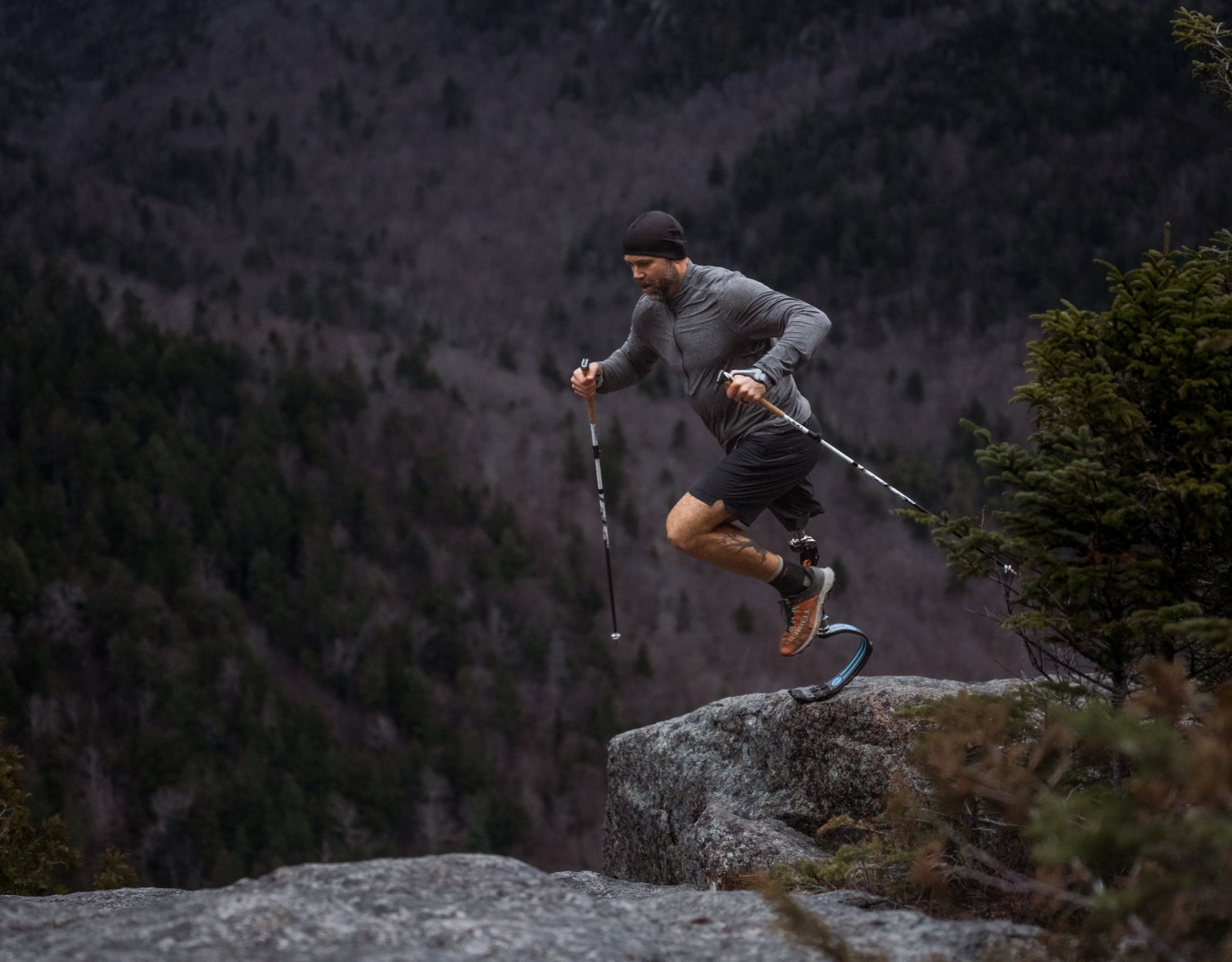
Plant the poles slightly ahead of your feet and use them to help propel yourself upward.
Avoid pulling excessively with your arms. Instead, push through the straps while maintaining a natural stride. As the terrain becomes steeper, transition from alternating pole plants to planting both poles together. This creates a stable platform that allows you to drive upward with each step. Steep climbs also provide the perfect opportunity to engage the powerful muscles in your shoulders, back, and core, helping transfer some of the workload away from your legs and improving climbing efficiency.
Descending
Longer poles increase stability.
Plant the poles slightly ahead of your body by reaching forward before each step to reduce impact on your knees.
Keep your elbows slightly bent to absorb shock.
Rocky Terrain
Place pole tips securely on stable surfaces.
Avoid planting poles on loose rocks that may shift under load or between roots and rocks. Loading the pole shaft when the tip is lodged between objects is the most common way to improperly load the pole, which may lead to damage.
Mud
Use slightly wider pole placement for additional stability.
If conditions are soft, larger baskets can help prevent excessive sinking.
Stream Crossings
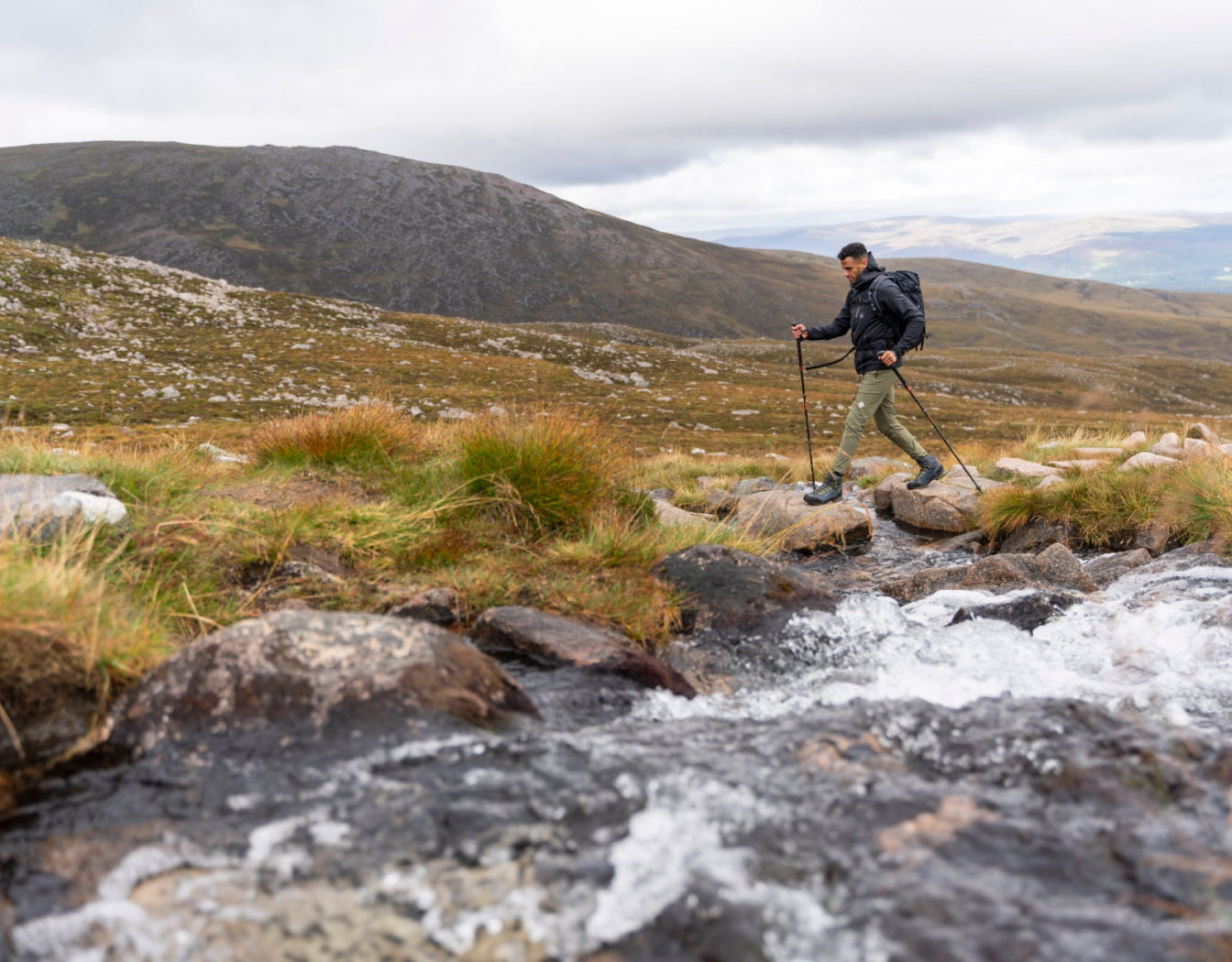
Plant both poles securely on the stream bed before stepping forward.
Always maintain three points of contact and move slowly and deliberately. Many rocks in the stream are prone to shifting when stepped on, so be cautious.

Snow
Snow baskets prevent poles from sinking too deeply.
Plant the poles firmly before transferring weight.
If you plan to spend much time crossing snow, we recommend traveling with a pair of LEKI trekking poles with a Flex Tip, making it simple to exchange baskets on the fly when trail conditions change. LEKI also makes four-season poles which are ideal for high alpine hikers and mountaineers.
Common Trekking Pole Mistakes
Gripping Too Tightly
Relax your hands.
The wrist straps should carry much of the load.
Using the Wrong Length
Poles that are too long fatigue your shoulders and reduce the benefit.
Poles that are too short force you to lean forward.
Both reduce efficiency.
Planting Too Far Ahead
Overreaching disrupts your natural stride.
Instead, plant the pole near your lead foot when climbing and lower down the trail when descending.
Forgetting to Adjust for Terrain
One pole length does not fit every trail. Trekking poles are adjustable to utilize this feature to help deliver optimal performance, comfort and efficiency.
Even small adjustments make a noticeable difference in comfort.
Aluminum vs. Carbon Fiber
Both materials perform exceptionally well but serve different priorities.
| Best For | Advantages | |
|---|---|---|
| Aluminum |
|
|
| Carbon Fiber |
|
|
Fixed-Length or Adjustable Trekking Poles?
| Best For | Advantages | |
|---|---|---|
| Fixed-Length Poles |
|
|
| Adjustable Poles |
|
|
For the vast majority of hikers, adjustable poles provide the greatest overall performance.
Why Grip Design Matters
The grip is your primary connection to the pole.
An ergonomic grip reduces fatigue and improves comfort during many hours on the trail.
Modern grip designs also improve wrist alignment and hand position, allowing more efficient power transfer.
Different grip materials offer different benefits:
- Cork naturally conforms to your hand and manages moisture well.
- Foam remains comfortable in cold conditions and absorbs vibration.
- Rubber provides durability and insulation in cooler weather.
Choose the grip that best matches your environment and hiking style.

Expert Tips from LEKI
For more than 75 years, LEKI has focused exclusively on designing high-performance poles. That experience has shaped several techniques that many hikers overlook.
| Expert Tip | Why It Matters |
|---|---|
| Adjust your poles often. | Changing pole length throughout a hike improves comfort and efficiency far more than leaving them in one position all day. |
| Let the straps do the work. | Proper strap use reduces fatigue and allows you to hike longer with less effort. |
| Keep your arms relaxed. | Efficient hiking comes from smooth movement, not muscle tension. |
| Match the pole to the activity. | Backpacking, day hiking, mountaineering, and fast hiking all benefit from different pole designs. |
Final Thoughts
Using trekking poles correctly is about much more than balance. Proper technique improves efficiency, conserves energy, reduces joint stress, and helps you move confidently through changing terrain.
With the correct fit, thoughtful adjustments, and relaxed technique, trekking poles become a natural extension of your body, allowing you to hike farther, recover faster, and enjoy every mile of the trail.
